By Fazeena Saleem
Qatar yesterday reacted sharply against Libyan leader Muammar Gaddafi’s criticism of Qatar and
Doha-based Al Jazeera news channel and said the country has free media and does not in any way interfere in its work.
An enraged Gaddafi had named Al Jazeera in his address to the nation on Tuesday and said it was one of the channels that were ‘turning and twisting facts’ about what was going on in his country.
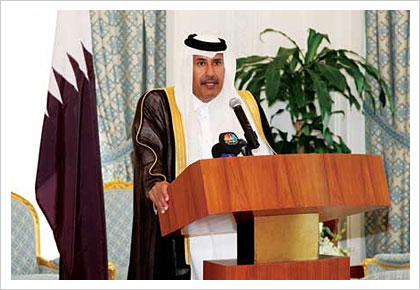
“We have a free press and we pursue a policy of non-interference in the media,” Qatar’s Prime Minister and Foreign Minister
H E Sheikh Hamad bin Jassem bin Jabor Al Thani told reporters here yesterday.
Addressing a joint press conference with his visiting British counterpart David Cameron, the PM who also holds the foreign portfolio, said:
“Qatar and Britain jointly condemn the use of force against the Libyan people.”
“Qatar is extremely pained by what is going on in Libya. We are with its people who are suffering. Qatar’s stand is clear and it should not be taken as interfering in its internal affairs,” said the Premier.
Libya has seen widespread protests in the last few days with Libyans demanding the ouster of its leader Muammar Gaddafi.
“Qatar has not committed any crime by standing behind the Libyan people, supporting them and rejecting violence by the Libyan government,” he added.
He further explained that Qatar is following the events in Libya with deep concern and hoped that the standoff will soon end. “Libya is an important country and is of concern to everybody. We do not seek to isolate it,” he added.
While expressing his concern over Libya, British Prime Minister Cameron called upon the governments to respond to the people’s demand for reforms. He also condemned the extreme use of force against people protesting for democratic reforms in Libya.
“We have been very clear with respect to Libya that what is happening there is unacceptable. The use of violence against their own people, the appalling scenes we have seen on our television screens — this is unacceptable and cannot be allowed to stand,” he said. “In Libya, the situation remains gravely concerning. We are doing everything that we can to protect British nationals and to assist them in leaving that country,” Cameron added.
Talking about other Middle Eastern countries, he made special references to Yemen and Iran.
“We also discussed the situation in Yemen, we are committed to helping president Saleh launch urgent political and economic reforms which the country needs to combat Al Qaeda in Yemen,” Cameron said.
Over Iran, the Tory leader expressed his country’s willingness for talks. “Britain and its international partners are ready to negotiate (with Iran) but we are not being taken for a ride. So we will continue to find ways to increase the pressure on Iran and we implement international sanctions,” said Cameron.
Sheikh Hamad bin Jassem stressed the need for clarity and openness in handling the Palestinian issue.
“It was very unfortunate and disturbing to see the US exercise its veto at the UN Security Council against the Arab draft resolution condemning the continued Israeli settlement activities in the occupied Palestinian territories,” he said.
“We are counting on Britain, which has a key role in reaching a fair outcome based on international legitimacy in the case of Israeli-Palestinian conflict.”
The Peninsula
|
 |